
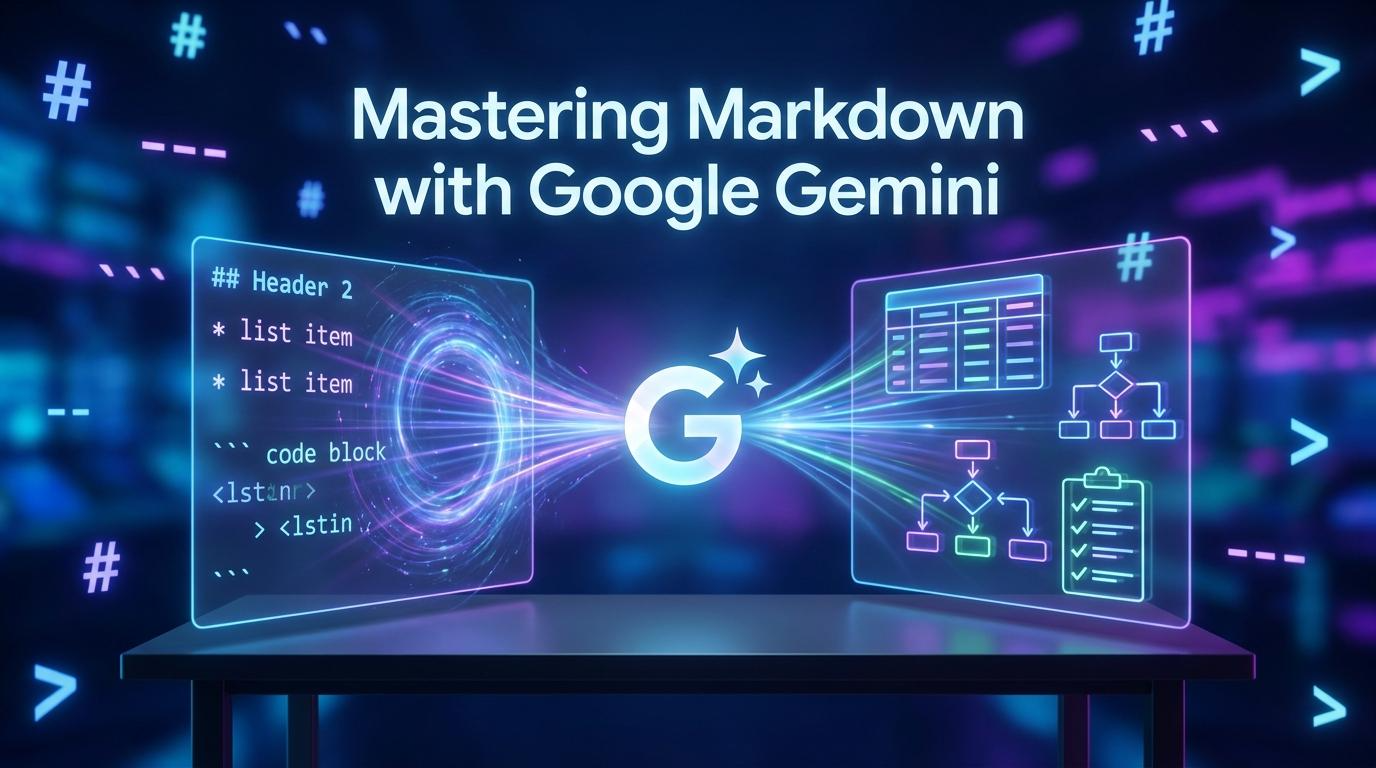

Why Your AI Chat Looks Like Magic
Ever notice how two people can use the exact same AI, but one gets an impenetrable wall of text while the other gets a beautifully structured masterpiece with tables and flowcharts? It’s not magic, and the AI isn’t playing favorites. The secret sauce is Markdown.
To LLMs like Google Gemini, Markdown is their native tongue. It’s remarkably lightweight, strips away the heavy HTML baggage, and takes way fewer “tokens” (computational brainpower) to process. It gives the AI a clean, structured cognitive map to organize its thoughts and present findings efficiently.
The Evolution: From Bloggers to AI Agents
Markdown started back in 2004 with John Gruber and Aaron Swartz. It wasn’t built for AI; it was just a pragmatic, plain-text escape hatch for bloggers who were sick of writing clunky HTML tags. Fast forward to the 2010s, and it became the gold standard for software developers—the default language of GitHub READMEs and technical docs.
Today, we’re in its third act: the AI Revolution. It’s no longer just a formatting tool; it’s a literal control surface. Think of PROMPT.md files used to dictate specific behaviors to AI agents. We use it to program machine behavior, not just format text.
Level Up Your Prompting Game
If you want to stop being a passive consumer and start architecting machine logic, you need structural prompting.
Input Hacks (Writing Like a Boss)
- The Hierarchy Trick: Use
#for main goals and##for sub-tasks. To an LLM, these aren’t just aesthetic choices; they are semantic signals that force deliberate, step-by-step “Chain of Thought” reasoning. - The Fenced Code Block: Use triple backticks to fence in your data. This creates a hard cognitive boundary so the AI knows exactly where your raw data ends and your instructions begin.
- Persona Frontmatter: Drop metadata at the absolute top of your prompt (e.g.,
Audience: Technical,Tone: Academic). This instantly calibrates the model’s linguistic parameters before it processes a single word of your request.
Output Hacks (Looking Sharp)
- Table Power-Ups: Asking for a comparison table forces the AI out of passive recitation and into active, synthetic reasoning.
- Mermaid Diagrams: Modern AI interfaces parse
mermaidcode blocks natively. Ask for a flowchart to translate abstract text into immediate visual logic. - Interactive Checklists: Ask for a “GFM (GitHub Flavored Markdown) task list” (
- [ ]). This generates interactive checkboxes you can seamlessly drop right into your own project management tools.
Why “Boring” Wins
Markdown quietly won the markup wars because it’s unpretentious and aggressively future-proof. Even if your rendering software crashes or the AI disappears, your raw text remains completely legible. It’s a portable standard across IDEs, Git repos, and conversational interfaces.
The catch? It makes generating massive, 50-page highly-structured documents too easy, leading to a “wall of text” problem. We’re suddenly drowning in beautiful technical guides that nobody will ever actually read because the ease of production has outpaced human consumption.
Vulnerabilities, Hallucinations, and Dialects
Relying on Markdown as an AI mediation layer introduces some unique bugs and structural failures.
- Sneaky Spies (Security): “Indirect Prompt Injection” is a pressing threat. Attackers can hide tracking pixels or malicious URLs inside Markdown image links on a webpage. When the AI summarizes it, it can trick your browser into fetching the payload, silently exfiltrating chat data. “ChatGPhish” even uses Markdown to render fake UI elements right in the chat.
- The Lies (Hallucinations): Sometimes the probabilistic engine misfires. The AI might forget a closing pipe (
|) in a table, breaking the whole structure, or hallucinate HTML tags that don’t actually exist. - Dialect Drama: Markdown is fractured into dialects like CommonMark and GFM. A table that renders perfectly in your web browser might look like a typographic car crash when passed through an API or a mobile app that parses it differently.
The Future: Living Markdown
Markdown is shifting from static descriptive text to a dynamic, interactive substrate. The horizon promises “Executable Markdown,” like MDX 2.0. Soon, AIs will generate docs with live React buttons, interactive data visualizations, and embedded metadata indicating source citations and confidence scores.
Furthermore, the standard chatbox paradigm is dissolving. Features like “Smart Canvas” point to a future where you and the AI co-inhabit a living document, editing the same Markdown architecture side-by-side in real-time.
Bottom Line: Start Hacking with #
Controlling these massive algorithmic engines is strikingly accessible and sits right on your keyboard. Next time you prompt, ditch the conversational paragraph. Use a # to define your core objective, fence your data, and ask for a table.
Markdown is the fundamental grammar of our new digital interlocutors. Mastering it is about establishing a higher quality of cognitive dialogue with the machine.